
Crown & Bridge
Single-unit crowns through long-span bridges: full-contour zirconia in all three yttria grades, IPS e.max, PFM, and full-cast restorations. Cases are designed on CAD/CAM where the workflow calls for it and finished by hand at the bench; PFMs and layered zirconia still get their porcelain from a technician, not a machine.
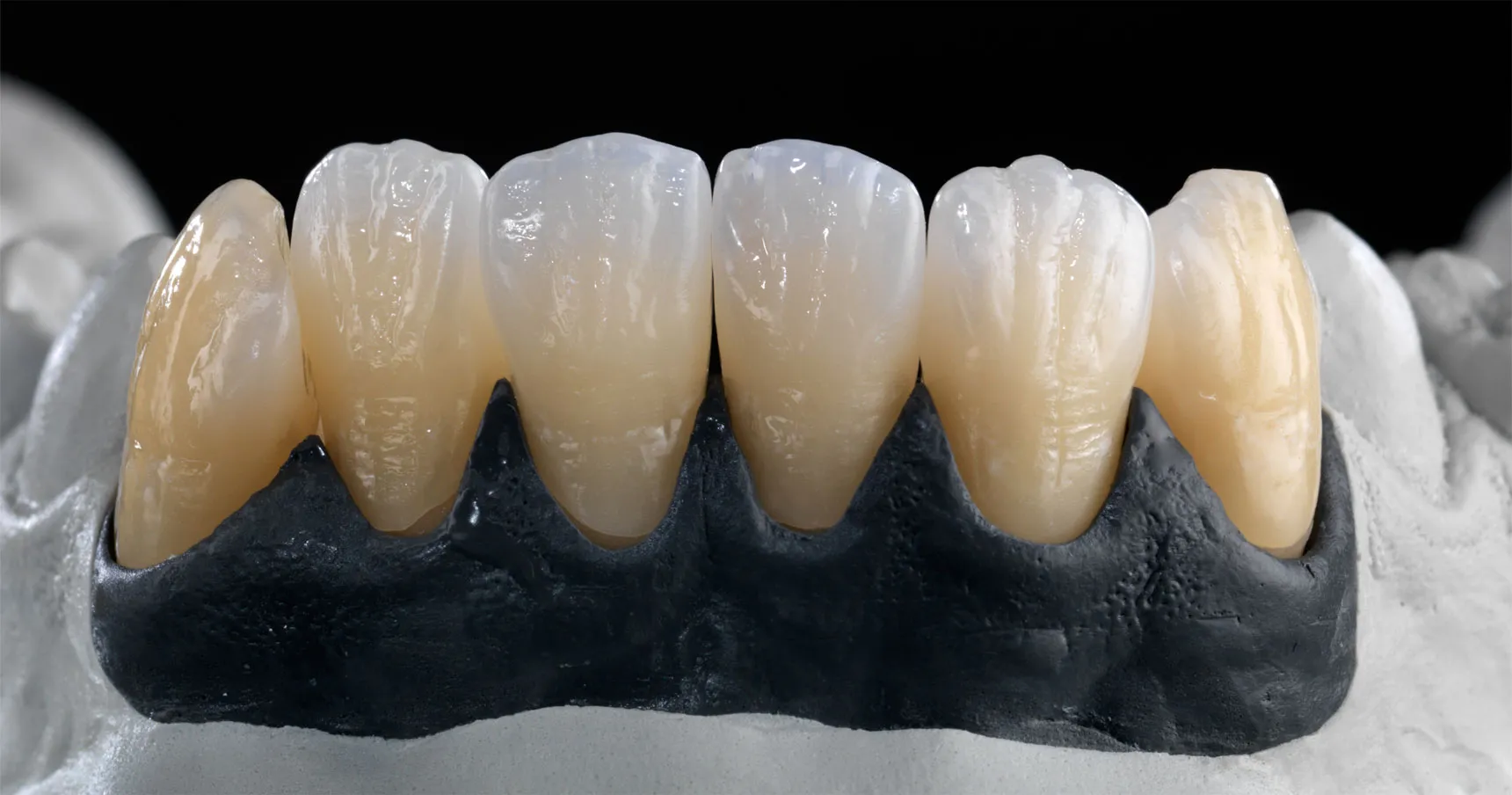
Selection Guide
| Material | Flexural Strength | Translucency | Reduction | Best For |
|---|---|---|---|---|
| IPS e.max Crowns | 500 MPa | Excellent |
|
|
| IPS e.max Veneers | 500 MPa | Excellent |
|
|
| Zirconia 5Y (SHT) | 650 MPa | Very good |
|
|
| Zirconia 4Y (HT) | 900 MPa | Good |
|
|
| Zirconia 3Y (Standard) | 1200 MPa | Fair |
|
|
| PFZ (Layered Zirconia) | 1200 MPa 3Y core, porcelain overlay | Excellent (hand-characterized) |
|
|
| PFM | Alloy-dependent | Limited (opaque metal core) |
|
|
| Full-Cast & Full Gold | Alloy-dependent | None (full metal) |
|
|
The Y number (3Y, 4Y, 5Y) is the zirconia’s yttria content: more yttria means more translucency and less strength. HT = high translucency, SHT = super high translucency. Zirconia reductions are minimums; 1.0–1.5 mm is ideal where space allows.
A model-free workflow is available on request for single-unit crowns, small-span bridges, and single-unit implant crowns. Ask about our model-free discount when you send the scan.
Full-Contour Zirconia
Full-contour (monolithic) zirconia is milled from a single block with no porcelain layer, so there is nothing to chip or delaminate. It comes in three yttria grades that trade strength for translucency: 3Y is the strongest and most opaque, 5Y the most translucent, 4Y the balance between them.
Zirconia 3Y (Standard)
The strongest grade at 1200 MPa, and the most opaque. It serves single crowns anywhere in the arch, and it is the grade for bridges of 4+ units and bruxism cases, where durability outranks translucency. When a case needs 3Y strength and esthetics, prescribe it as a PFZ: hand-layered porcelain over the same 3Y core.
- Single crowns anywhere in the arch
- Bridges of 4+ units & heavy function
- Minimum 0.6–0.8 mm reduction
Zirconia 4Y (High Translucency)
The balanced grade: 900 MPa with enough translucency for everyday molar and premolar single crowns, and rated for 3-unit bridges anywhere in the arch.
- Posterior single crowns & 3-unit bridges
- Minimum 0.8–1.0 mm reduction
- Multilayer shading available
Zirconia 5Y (Super High Translucency)
The most translucent grade at 650 MPa, for anterior single crowns, veneers, and 3-unit anterior bridges as far back as the premolar. Longer or fully posterior spans step up to 4Y or 3Y, and we tell you when they do.
- Anterior single crowns, veneers & 3-unit bridges
- Minimum 0.8–1.2 mm reduction
- Multilayer shade gradients
PFZ (Layered Zirconia)
Hand-layered porcelain over a high-strength 3Y zirconia substructure for fully customized anterior esthetics; a technician builds the shade in porcelain, layer by layer.
- Custom stain and hand layering
- Minimum 1.5–2.0 mm incisal/occlusal reduction
- 3Y zirconia substructure strength
IPS e.max (Lithium Disilicate)
IPS e.max is a lithium disilicate glass-ceramic that bonds to tooth structure and transmits light the way enamel does, which is why it remains the esthetic standard for single anterior units. At 500 MPa it serves single-unit work: anterior and premolar crowns, veneers, and inlays/onlays; Ivoclar reports 97.2% ten-year survival for posterior e.max crowns. We run e.max on single units only; bridges of any span go to zirconia, as do confirmed bruxers and substantially reduced dentition per Ivoclar’s IFU. Note the opposing dentition on the slip and we’ll flag it before we start.
e.max Crowns
High translucency and shade blending for anterior and premolar single crowns where esthetics lead the prescription. Single units only; bridges go to zirconia.
- Anterior and premolar single crowns
- 1.5 mm incisal/occlusal; 1.2–1.5 mm axial
- Minimally invasive to 1.0 mm when adhesively bonded
e.max Veneers
Thin, conservative veneers with natural color and contour for anterior esthetic cases.
- 0.6 mm facial (0.3 mm thin veneers)
- Custom shade matching
e.max Inlays & Onlays
Bonded partial-coverage restorations that preserve healthy tooth structure.
- Conservative preparation
- Adhesive cementation required
- Minimum 1.0 mm reduction
PFM & Full-Metal
Metal-based restorations for the cases that call for them: deep margins, long spans, and heavy function.
Porcelain-Fused-to-Metal (PFM)
Metal-ceramic restorations in four alloy tiers: non-precious, semi-precious, and high noble in white or yellow gold.
- Four alloy tiers
- Reliable for deep margins and long spans
- 1.5–2.0 mm functional cusp under porcelain
Full-Cast Metal Crowns
Full-metal restorations in non-precious and semi-precious alloys, for cases where strength and marginal integrity outweigh esthetics.
- Close marginal adaptation
- Strong in limited clearance
- Common choice for second molars
Full Gold Crowns
High noble gold is biocompatible and inert in the oral environment, casts to a fine, burnishable margin that resists microleakage, and needs the most conservative preparation of any full-coverage crown. Under load the ductile alloy deforms rather than fractures, and its wear rate approximates enamel, minimizing wear of the opposing dentition. With documented service measured in decades, it remains the choice where longevity leads: second molars, limited clearance, and heavy function.
- Inert, biocompatible high noble alloy
- Burnishable margins, resists microleakage
- Decades of documented service in the literature
Bridges
Fixed multi-unit restorations in zirconia or PFM, with connectors sized digitally to the span and load.
Zirconia & PFM Bridges
From three-unit bridges to long-span cases in standard zirconia, with the material matched to span and location.
- Digitally designed connectors
- Material matched to span and load
- Zirconia or PFM
Maryland (Resin-Bonded) Bridges
Conservative single-tooth replacement with a bonded cast-metal wing, most often for lower incisors.
- Minimal preparation of abutment teeth
- Cast-metal wing design
- Commonly used for lower anteriors
Prep, Provisional & Diagnostic Services
Supporting services for fixed cases.
PMMA Temporary Crowns
Milled provisionals that hold tissue and occlusion while the final restoration is fabricated.
Virtual Diagnostic Wax-Ups
Digital wax-ups for planning esthetic cases and reviewing the proposed contours with the patient before treatment begins.
Post & Core
Cast post-and-core foundations for structurally compromised teeth ahead of crown placement.
Turnaround Times
| Service | Turnaround |
|---|---|
| All fixed restorations: crowns, veneers, inlays/onlays, and bridges (zirconia, e.max, PFM, full-cast) | 12 business days |
- Business days are Monday–Friday, excluding holidays.
- Working times are in-lab only and exclude pickup, delivery, and shipping days.
- Multi-step removable cases: total time = number of steps × days per step.
- Rush service is available for an additional fee. Call to schedule rush cases.
Warranty Terms
2 years · crowns & bridges
6 months · removable prosthetics
6 months · ortho & appliances
90 days · repairs & relines
All restorations are warranted against defects in materials and workmanship when fabricated to your specifications, from the delivery date. Coverage is repair or replacement at our discretion; it does not extend to patient misuse, accident, anatomical changes, parafunctional habits, or work altered elsewhere.
Common Questions
Which zirconia should I prescribe?
Prescribe by span and by how hard the patient loads:
- 3Y (1200 MPa): single crowns anywhere in the arch, bridges of 4+ units, and heavy bruxers. Strongest, least translucent.
- 4Y (900 MPa): the everyday posterior single crown, and 3-unit bridges anywhere in the arch.
- 5Y (650 MPa) or e.max: the esthetic zone: anterior single crowns and veneers. 5Y also covers 3-unit anterior bridges through the premolar; e.max stays single-unit.
Not sure? Note the tooth number and opposing dentition on the slip and a technician will recommend a material before we start the case.
Do you accept physical impressions, or digital only?
Both. We take scans from the major intraoral systems (see the Send a Scan page) and physical impressions, with courier pickup across the San Gabriel Valley and greater Los Angeles and shipping from everywhere else. Impressions enter the same design workflow as digital cases.
Can I send digital scans without a physical model?
Yes, a scan is all we need to start, and we print a model when the case calls for one. On request we also run a model-free workflow: the restoration is designed and finished without a printed model, at a discount. Model-free is available for single-unit crowns, small-span bridges, and single-unit implant crowns; we don’t recommend it for other case types, and a model-free crown may still need minor chairside adjustment at delivery.
How much reduction do your materials need?
Zirconia needs the least; PFM the most:
- Zirconia: 0.6–0.8 mm minimum for 3Y; 1.0–1.5 mm ideal where space allows.
- e.max crowns: 1.5 mm incisal/occlusal and 1.2–1.5 mm axial. A minimally invasive e.max crown can go to 1.0 mm circumferential when it is adhesively bonded.
- e.max veneers: 0.6 mm facial, or 0.3 mm for pressed thin veneers.
- PFM: 1.5–2.0 mm on functional cusps wherever porcelain covers the occlusal.
- Full-cast & full gold: 1.5 mm on functional cusps and 1.0 mm on nonfunctional, with a 0.5 mm chamfer: the most conservative full-coverage preparation.
The Selection Guide on the Crown & Bridge page lists every material side by side; some clinical situations call for more.
How should I communicate shade?
VITA Classical and VITA 3D-Master are our working systems, and either is preferred. Any other shade guide works too: name the guide on the slip and we convert it. For e.max and 5Y zirconia, include the stump shade as well; both materials are translucent enough that the underlying preparation shows through and changes how we build the shade.
A shade photo helps on any esthetic case. What makes one useful:
- Two or three shade tabs in frame: the closest match plus a neighbor on either side, held edge-to-edge in the same plane as the tooth with the labels readable. Bracketing tells the ceramist far more than a single tab.
- Taken before dehydration: shoot at the start of the appointment; isolated teeth dry out within minutes and photograph whiter than they are.
- Phone camera: flash off, no zoom, no filters or beauty mode. Tap the tooth to focus, then drag the exposure slider down slightly so the enamel isn’t blown out. Daylight or a neutral (about 5500 K) light source beats the overhead operatory light.
- Dedicated camera: ISO 100–200, white balance 5500 K (the flash preset), shutter 1/125–1/200 with flash, and f/16–f/22 for depth of field.
- Cross-polarization (optional): a polarizing filter removes surface glare and reveals the underlying shade and characterization; a nice upgrade, but not required. Plain, slightly underexposed photos work.
Send photos with the case through your scanner portal, or call the lab and we’ll set up the right channel.
What cement should I use for zirconia and e.max?
These are general guidelines. We recommend checking your cement manufacturer’s instructions, and following them wherever they differ.
Zirconia (3Y, 4Y, 5Y): two valid paths, chosen by the prep.
- Retentive prep: conventional cementation with resin-modified glass ionomer (RMGI). No etching, priming, or bonding steps.
- Short or over-tapered prep: bond it. Clean the intaglio after try-in (Ivoclean or 5% NaOCl, not phosphoric acid), air-abrade with 30–50 µm alumina, apply an MDP-containing primer, and seat with a dual-cure resin cement; the crown blocks the curing light, so the cement must also cure chemically.
- Never HF-etch zirconia: it has no glass phase to etch.
e.max (lithium disilicate): adhesive bonding is the default.
- Veneers & minimally invasive crowns: must be bonded. Etch with 5% HF for 20 seconds, apply silane (or a one-bottle etch-and-prime), and seat veneers with a light-cure resin cement, the most color-stable under thin ceramic.
- Full-coverage crowns: same etch-and-silane protocol with a dual-cure resin cement; a retentive prep can instead take a self-adhesive dual-cure resin cement with no separate etch step.
PFM, full-cast & full gold: conventional cementation with RMGI or conventional glass ionomer. No bonding protocol needed.
Can zirconia be adjusted chairside?
Yes. Use a fine-grit diamond with water spray and light pressure, then repolish with a zirconia polishing kit; a well-polished surface is what keeps zirconia kind to the opposing dentition, and the literature finds polished zirconia less abrasive than glazed. If an adjustment is larger than a polish can recover, send the restoration back and we re-glaze it on request.
What should I send with a crown or bridge case?
- Prep and opposing: a scan or impression of the prepared arch, plus the opposing arch.
- Bite registration: covering at least the prepared quadrant, in occlusion.
- Tooth number, material, and shade: on the slip, with the opposing dentition noted; add the stump shade on e.max and 5Y cases (see “How should I communicate shade?”).
- Margins: if any part of the margin is uncertain in the scan or impression, mark it or note it on the slip.
If anything we need is missing (margin, shade, or opposing), we call the office before we start the case.
When will you tell me a material won’t work for a case?
Before we start it. If the prescribed material doesn’t fit the case in front of us (a 5Y crown on a heavy bruxer, e.max where the prep can’t give it room, a span too long for the zirconia grade), a technician calls with the reason and the alternative before anything is milled or pressed. Note the opposing dentition on the slip and we’ll catch it at design.
What warranty do you offer on Crown & Bridge work?
Two years against defects in materials and workmanship, from the delivery date, when the restoration is fabricated to your specifications. The remedy is repair or replacement at our discretion. Full terms are published on the Crown & Bridge page, next to the turnaround table.
Send us your next crown or bridge case
Call to schedule a pickup, connect your scanner, or start a Digital Lab Slip. Turnaround times for each product are listed above.